What is the Modeling?
Modeling is a cornerstone of scientific research and systems analysis, providing structured, simplified, and often computational or mathematical representations of real-world phenomena or systems to gain insights into its behavior, dynamics, or future outcomes. In the context of energy and climate systems, models help decision-makers understand trade-offs, test policies, and predict system performance under various scenarios. The selection of an appropriate method depends on both the characteristics of the underlying system and the specific research question being addressed. For instance, in the context of local markets, the presence of numerous decision-makers typically necessitates the extensive use of simulation-based models. In contrast, at larger scales, energy system optimization models and integrated assessment models (IAMs) are generally more appropriate and therefore more commonly employed.
Mathematical optimization models, as a branch of models, seek the best solution to a problem under given constraints, central to resource allocation in energy and land systems. Among optimization methods, linear programming (LP) widely applied to energy systems which optimizes a linear objective (e.g., cost, emissions) subject to linear constraints (e.g., supply, demand, emission targets, land limits) to support energy system planning. The widespread use of LP models for energy systems stems from their sheer size, which makes solving the resulting optimization problems computationally challenging. However, among the various classes of mathematical optimization models, LP has benefited from the development of highly efficient solution methods that enable such large-scale problems to be solved within reasonable time frames. In the context of energy systems, the general LP structure is:
where the objective function and the constraints assume linear relationships between decision variables \((x)\). The objective function guides the optimization model toward a solution that minimizes cost or emissions, while the constraints ensure that the solution is technically feasible. For \(m\) constraints and \(n\) decision variables, \(c \in \mathbb{R}^n\) is the cost coefficient vector, \(A \in \mathbb{R}^{m \times n}\) is the constraint matrix, and \(\mathbf{b} \in \mathbb{R}^m\) encodes upper bounds for the resource limitations.
BENOPTex Modeling Framework
BENOPTex consists of various standalone modules for the heat sector, transport sector, and chemical industries. These sub-modules will be hard-linked to create a panorama view of the bioenergy and bieconomy landscape. Figure bellow depicts all the related components for the base of the BENOPTex model. Sub-modules of the integrated model will be further developed to include a broader set of technologies and products. For instance, the bioeconomy module, which currently provides pathways to produce ammonia, methanol, ethylene, succinic acid, and bioplastic, will consider negative emission technologies (NETs). Also, the extended model benefits from the DBFZ data repositories , LPJmL and FORMIND to have an updated perspective regarding the availability of biomass resources given the future climate scenarios.
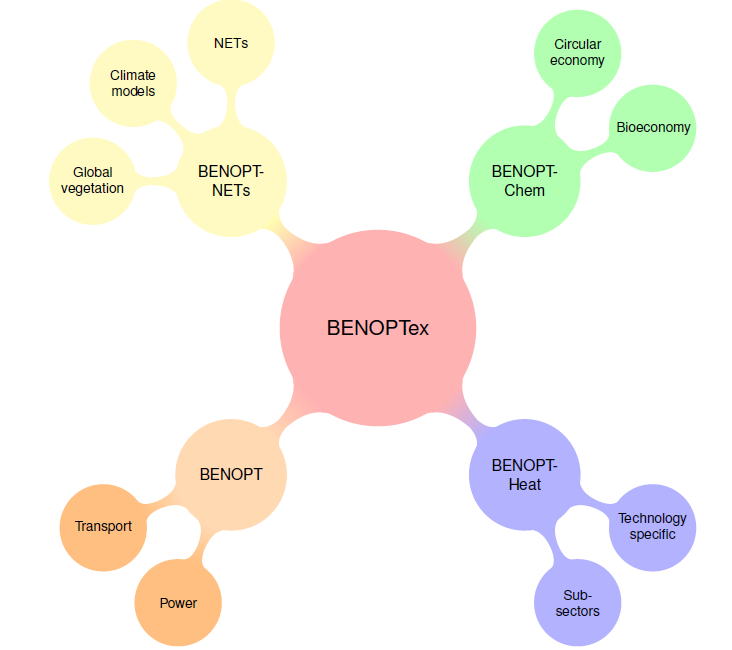 Figure 1: Hard-linking BENOPT sub-models in order to paint a panorama view of the bioenergy and bieconomy.
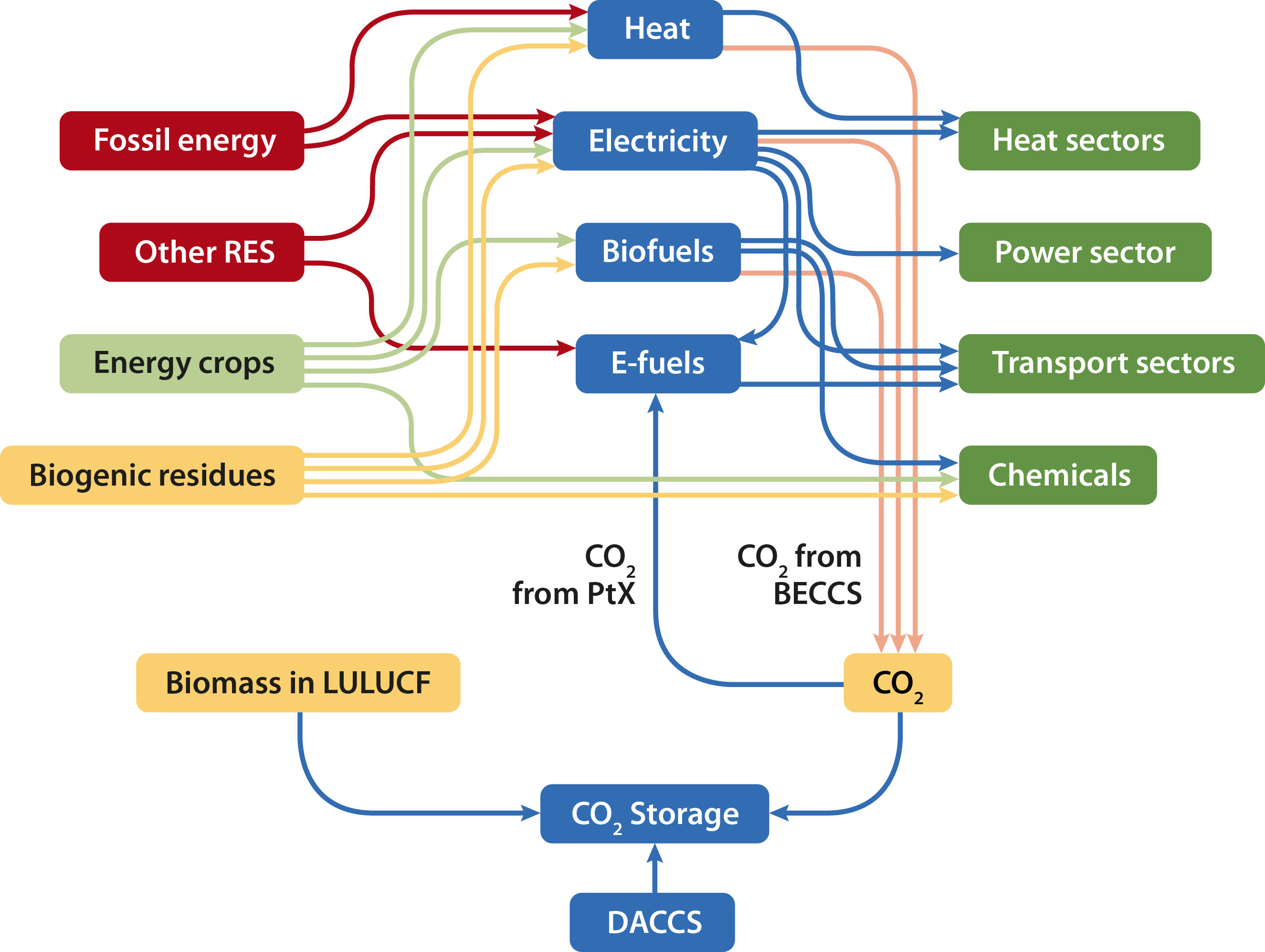
BENOPTex is a state-of-the-art, deterministic, bottom-up, linear optimization model with perfect foresight developed to determine the cost-optimal deployment of dispatchable renewable energies in Germany, considering technical, economic characteristics, biomass supply and climate and policy constraints. The model integrates renewable technologies, and assesses their impact across various sectors, including power, heat, transport and chemicals. The model has been applied in detailed studies of the German energy and land system but is generalizable to other countries with suitable data inputs. Developed in GAMS and interacting with MATLAB, it enhances spatial, technological, and sectoral resolutions for more accurate analysis. Fig. 2 depicts the system boundary of BENOPTex, showing how primary energy carriers are converted into secondary energy carriers through conversion technologies to meet energy demands in different sectors.